
Using new plastics correctly in injection molding simulation
Creating missing material data for injection molding simulation thanks to in-house material characterization

Calculating parts made of new plastics correctly with your own material card
The properties of plastic parts depend not only on the actual material properties and the part design, but also significantly on the process technology. This includes, for example, the injection molding process and the injection mold.
That is, without first defining where the gate is located, how efficient the mold temperature control is, and which injection molding parameters influence, for example, shrinkage (warpage) or filler orientation, no definitive statement can be made about the properties or geometry of the final injection molded part.
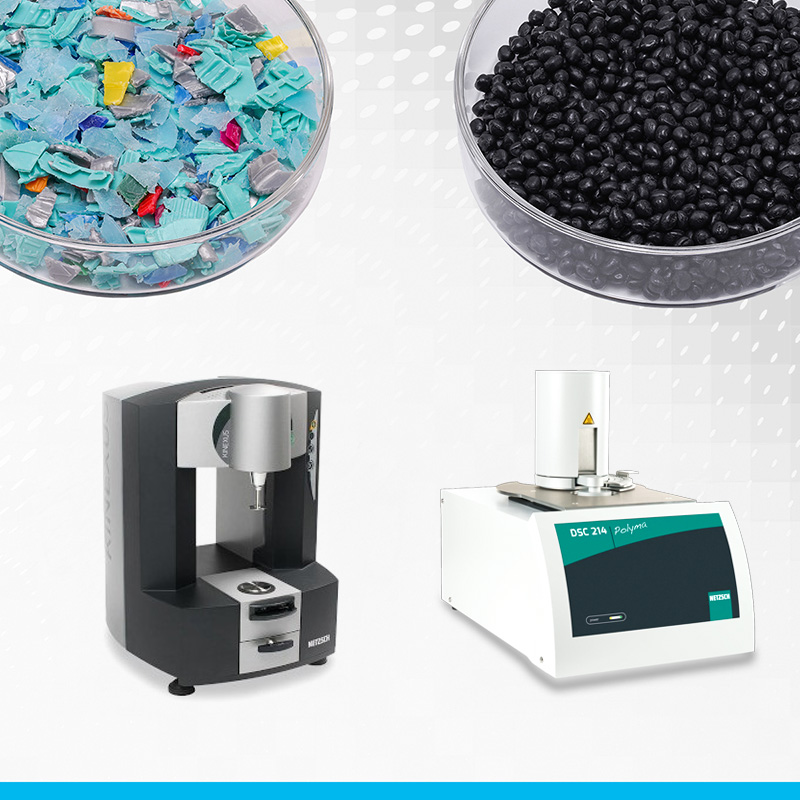
For the simulation of the processing behavior of plastics (injection molding simulation such as filling simulations), e.g. in an injection mold, various software solutions are available on the market. To be able to simulate a specific part project, however, in addition to this software the respective “material data” are required.
Missing material data and plastic types in simulation software
The more precise and comprehensive this material data is, the more realistic the simulation result will be compared with a real part. Classic technical data sheets contain almost no relevant values that are necessary for simulating mold filling and shrinkage behavior. At least the following should be available:

Thermal conductivity
Heat capacity
Density
Viscosity function
For many “classic”, frequently used plastic types, this data is available in the material libraries of the software programs. And in projects, material data from “similar” materials are often used when no data is available for the specific material.
However, when it comes to “novel” polymers that have no suitable equivalent, this material data must be determined. And such materials are, and will in future be, increasingly important:
Biopolymers
PIR and PCR materials (recycled materials)
Thermoset materials (e.g. epoxy resins, phenolic resins, BMC)
We simulate with the processing simulation software Moldex3D and determine our material data (rheometer, DSC) ourselves in order to be completely sure about the quality of this data. In addition, we have a network of universities and industry partners when it comes to making simulations even more accurate, e.g. through pvT data to optimize the prediction of shrinkage/warpage.
Simulating part production with the help of reliable material data offers great potential to identify optimization approaches early, which can then be implemented in a prototype or production tool.
Injection molding simulation for epoxy resins – reactive polymers as the basis for injection moldable molding compounds
Epoxy resins are not as unfamiliar to us as it may first seem. Anyone who has ever repaired something with a two-component adhesive has already come across this material and its special characteristics.
Here, a resin and a hardener (figure 1, left) are mixed, which starts a chemical crosslinking reaction (figure 1, center), i.e. the curing process. Parts generally referred to as “carbon fiber” or “carbon” are also based, for example, on epoxy resin-hardener systems, which here also serve as “adhesive” and during production first infiltrate the fiber products and then, so to speak, bond them firmly.
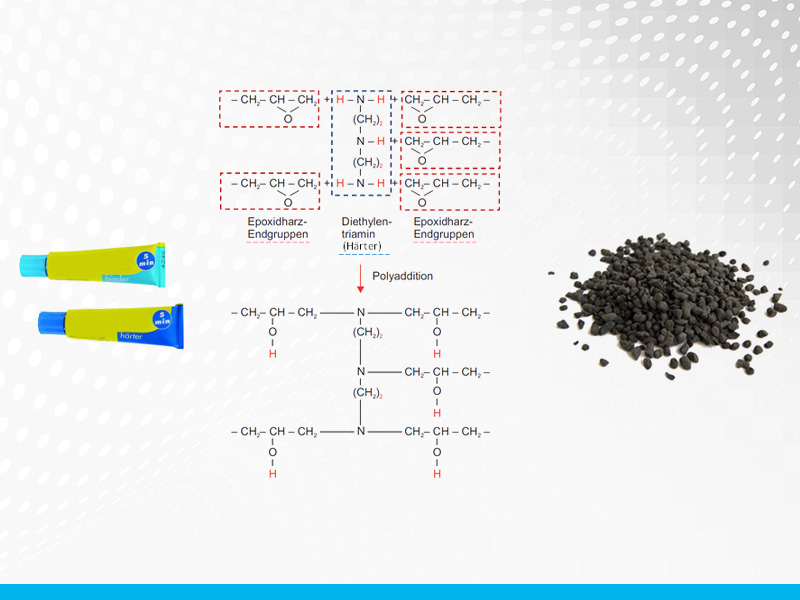
The same chemical principle of resin and hardener is also found in thermoset molding compounds for injection molding, right side of the image (see our technical blog post Thermoset injection molding in e-mobility). Here too it is a resin-hardener system, but adjusted so that it is a solid and shows almost no chemical reaction at moderate temperatures (slightly cooled to room temperature).
Therefore, these materials can be produced as ready-compounded molding compounds (resin, hardener, fillers and reinforcing materials, additives, etc.), e.g. in granule form, and stored for a certain time. Only at elevated temperatures does the chemical crosslinking reaction start in an accelerated way, which is exploited during processing in heated injection molds.
This material structure, consisting at first of resin and hardener that then combine into a 3-dimensional network, also makes it possible to investigate the material structure and its change through the crosslinking reaction by means of thermoanalytical methods (e.g. DSC).
Uncrosslinked vs. crosslinked material state in thermosets
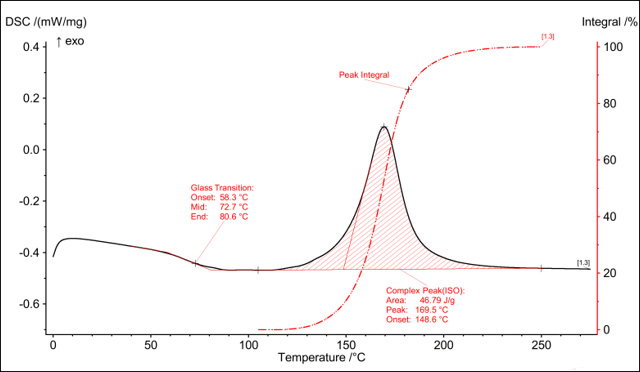
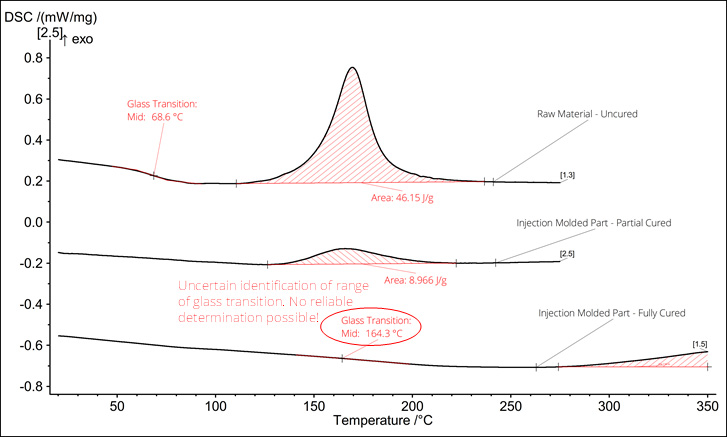
A distinction must be made here between the uncrosslinked and the crosslinked material state. The uncrosslinked, oligomeric resin is in an amorphous state, so that the phase transition from solid to liquid (glass transition) can be measured by DSC analysis (Differential Scanning Calorimetry). A “step” occurs in the heat flow signal – in the following curve diagram approx. between 60 and 90°C. The reason for this is the change in the heat capacity of the material during the phase transition. The evaluation of this step describes the glass transition range with the glass transition temperature TG_0 of the uncrosslinked resin and thus gives a first indication of the necessary lower processing temperatures in the plasticizing unit of the injection molding machine.
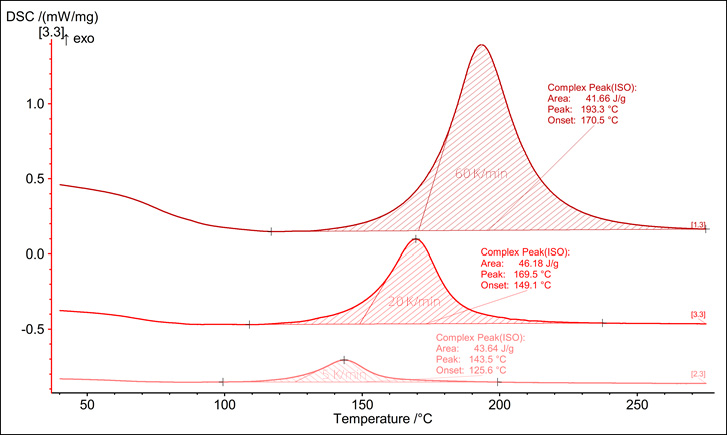
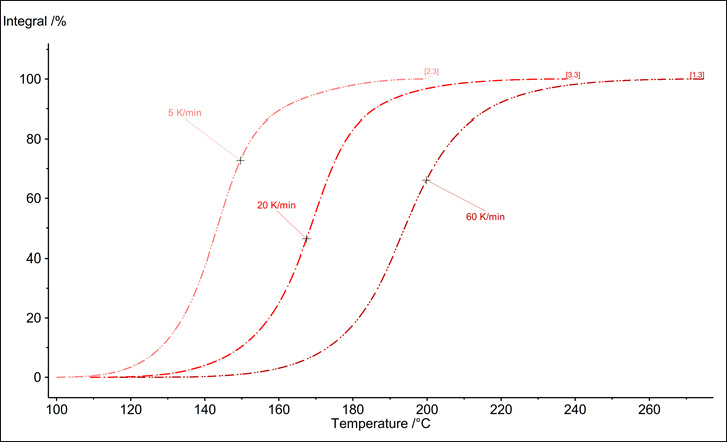
If one considers the further course of the heat flow signal, an exothermic effect occurs at higher temperatures, which appears as a peak (image, Complex Peak (ISO)). This exothermic peak characterizes the chemical crosslinking reaction, where the area of the peak represents the reaction heat that occurs and the integral represents the reaction enthalpy. The course of the integral (image, Peak Integral) describes the crosslinking progress. If the peak integral is differentiated with respect to time (da/dt), the reaction dynamics are obtained. From a processing point of view, for example, an upper temperature limit for plasticizing can be derived from the starting point of the exothermic peak, and an optimal mold temperature from the steepest rise of the integral.
The following image shows the different results of the DSC analysis of an epoxy resin in different crosslinking states. As described before, the uncrosslinked starting material (upper graph) shows a clear glass transition range with the glass transition temperature TG_0 followed by the exothermic crosslinking peak. The integral of the peak (area) describes the total crosslinking enthalpy.
The middle graph shows the DSC signal of an injection molded part, but with incomplete crosslinking. A glass transition range can no longer be seen, as it continues to rise dynamically during the measurement with the post-crosslinking that starts at elevated temperatures. As already indicated, the exothermic peak describes the post-crosslinking or residual crosslinking. The degree of crosslinking can be determined from the ratio of total crosslinking enthalpy to residual crosslinking enthalpy: α=100-((residual enthalpy ∙100)/total enthalpy). In the example shown, the degree of cure of the part is around 81%. That means the injection molding process should be optimized again here.
The bottom graph 3 shows the DSC signal of a fully cured part. As there is no further chemical crosslinking reaction here, no exothermic effect can be observed anymore. In theory, the glass transition at complete curing TG_1 can be determined instead. However, with the typically highly filled injection molding compounds it is so weakly pronounced that the determination does not always succeed reliably, especially since the evaluation range for TG_1 often overlaps with the range of thermal degradation. This becomes visible as an exothermic rise of the curve at very high temperatures (hatched area from approx. 270°C). Therefore, determining the glass transition temperature of cured parts by DSC is not recommended; thermomechanical analysis (TMA) is significantly better suited for this.
Reaction dynamics for injection molding simulation of plastics
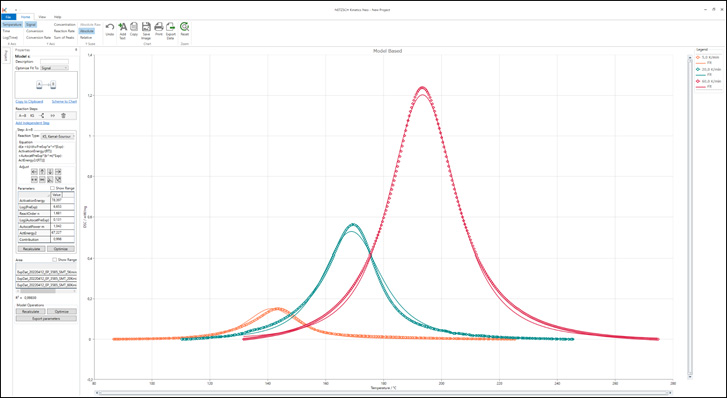
In addition to using DSC analysis to check the curing state, it also serves as a basis for generating material data for process and curing simulations. For this purpose, several DSC analyses are performed at different heating rates (following images) and the reaction dynamics curves are then converted into mathematical models. For injection molding epoxy resin compounds, for example, the so-called Kamal-Sourour model has become established: dα/dt=(A∙exp(-T_a/T) +B∙exp(-T_b/T)∙α^m ) (1-α)^n. Such models now allow the simulation to calculate arbitrary crosslinking scenarios as a function of time and temperature. The data fitting can be carried out, for example, with Netzsch Kinetics Neo, as shown in the image below.
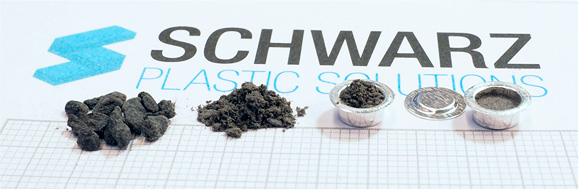
Regarding sample preparation for epoxy resin-based injection molding compounds, the following procedure has become established: aluminum pans/lids are used, with the lids being perforated. (For other types of molding compounds, e.g. phenolic resin-based ones, special pressure-tight pans must be used.) The granules are ground into a powder, if possible without thermal input, and “carefully” pressed in the pan (see image below). This significantly increases contact with the bottom of the pan as well as thermal conduction within the sample, which leads to very consistent and highly reproducible DSC curves.
Especially for crosslinking plastics such as thermosets, exact material cards are crucial for a realistic injection molding simulation, as otherwise the reaction and the chemical crosslinking are not correctly taken into account. This can later be recognized by defective parts and process problems.
We are happy to support you in creating your individual material card for injection molding simulation.