
Materials science of plastics: thermosets / duromers
What are thermosets – and how do they differ from thermoplastics?

strong through chemical crosslinking - thermosets are reactive plastics
Thermosets are crosslinked polymers. Like thermoplastics, they consist (in the cured state as a component) of long “poly” chains of molecules (monomers). The special feature of duromers, however, is that these molecular chains are linked to one another by chemical bonds. This creates an extremely stable three-dimensional molecular network.
These chemical links of thermosets are enormously strong compared with the purely physical bonding forces found between the molecular chains of thermoplastics. And these chemical bonds in thermosets remain strong and dimensionally stable even under the influence of heat.
In contrast, the physical bonding forces in thermoplastics decrease as temperature rises and lead to major changes in properties up to plastic deformability (glass transition range, crystallite melting range).
Properties of thermoset plastics
Their typical properties (service/component properties) can be traced back to this chemically crosslinked structure, which all thermoset materials share:

High hardness and stiffness
High heat deflection resistance
Wide chemical resistance
Low thermal expansion (similar to some metals)
Non-swelling and non-meltable
Minimal ductility (hardly any plastic deformation)
Electrically and thermally insulating
In addition to these service properties, thermosets also have extremely advantageous processing properties of their own. Thermoset materials initially consist of uncrosslinked molecular chains (oligomers, i.e. shorter than in thermoplastics) – the reactive resins. Put simply, these resins react with specific hardeners (resin-hardener systems) in a chemical reaction to form the actual thermoset. The technological advantage resulting from this is that, owing to their “short” molecular chains, the resins have a relatively low viscosity. That means very good flowability.
Special properties in the processing of thermosets
High proportions of fillers and reinforcing materials possible (up to 80%)
High infiltration potential, e.g. of fibrous materials and wire windings
Low-pressure part production, e.g. for sensitive electronic components
Thin part wall thicknesses possible, e.g. for overmolding/encapsulating
Flash formation (disadvantage)
The particularly good flowability of the material can be advantageous in processing when low injection pressures are required, e.g. when overmolding sensitive components such as circuit boards, PCBs, stators, rotors or bipolar plates. Read more about the possibilities with thermosets in electromobility and also the announcement on the successful series implementation of an electric axial flux motor with Mercedes-Benz.
Processing of thermosets
Thermoset injection molding like thermoplastics?
Temperature makes the difference
The basic process sequence in injection molding of thermoset molding compounds is analogous to that of thermoplastics. Thermoset molding compound: this is the ready-to-process material made of resin, hardener, fillers and reinforcing materials as well as all other necessary additives. The process phases of plasticizing, injection, holding pressure and solidification/curing are run through as a cycle. However, the individual phases differ with regard to the material-specific machine and tool components as well as process parameters.
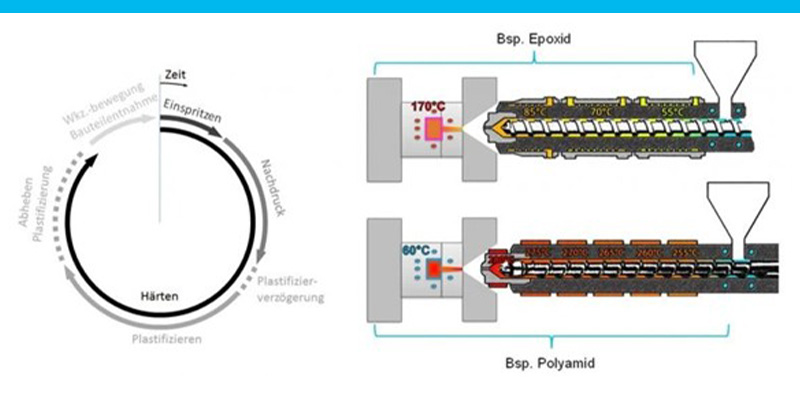
The most obvious difference at first is the quasi “reversed” temperature control. Thermoset molding compounds are plasticized as gently as possible in media-heated barrels at temperatures of max. 90°C (material-specific) in order to prevent the crosslinking reaction from starting prematurely. This also includes moderate back pressures, screw speeds and screw core compression. As a highly viscous melt, they are then injected into a mostly electrically heated tool. During holding pressure and a remaining curing time (analogous to the remaining cooling time for thermoplastics), the chemical crosslinking or curing reaction takes place. Mold temperatures of up to approx. 180°C accelerate this process.
Afterwards, the part can be demolded and removed in the hot state. In this state it is irreversibly chemically crosslinked and can no longer be melted by the influence of temperature. In addition to these basic process characteristics, there are of course a whole series of important material-specific details to be considered, especially regarding tool and process design.
See also the technical article on properties of thermosets in K-Zeitung (in German).
Thermoset curing: complete crosslinking through post-curing
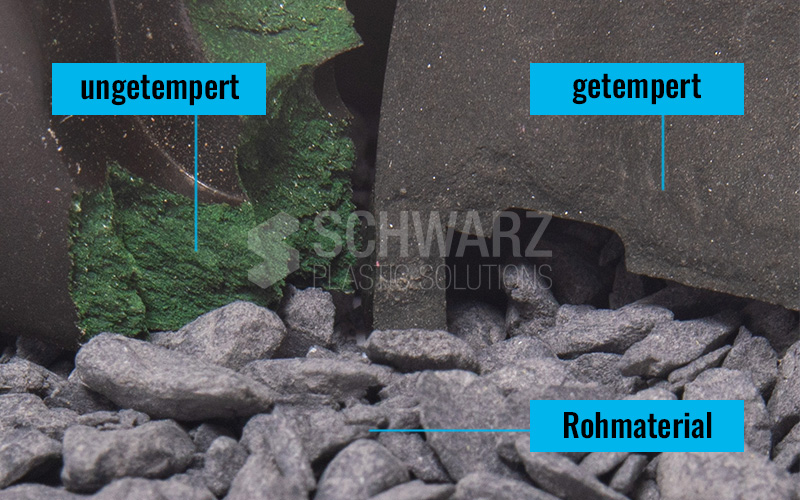
During the injection molding process, a large part of the crosslinking in thermosets already takes place through the chemical reaction. Nevertheless, the parts are usually not completely cured in the core (especially with thicker wall thicknesses). The maximum strength of the parts is only reached with complete curing.
Therefore, thermoset processing uses a downstream post-curing process in a special oven, in which a controlled temperature profile is run over a longer period (so-called tempering curve). This is necessary because gases escape from the material during chemical crosslinking and, if the reaction takes place too quickly, the parts burst open. Depending on the material (resin/hardener), fillers and part geometry, the tempering curves are programmed individually, thus achieving gentle, complete curing.
Meanwhile there are efforts and successfully used sensor technologies that measure, by dielectric analysis, the ion viscosity of the molecular structure of the plastic in the mold cavity. This information provides insight into the degree of cure of the material, already in the mold during the injection process. We use this technology in our injection molding technical center and can thus better tune the processes for you.
Thermosets: which materials are there?
Thermoset molding compounds is the umbrella term for a large number of different materials – not only with regard to fillers and reinforcing materials, but above all with regard to the resin base. As with thermoplastics, where there are polyamides, polypropylenes, polycarbonates etc., there are also different types of duromers. Industrially relevant thermoset materials are:
Epoxy resin (EP)
Phenolic resin (PF)
Unsaturated polyester resins (UP)
Vinyl ester resin (VE)
Melamine resin (MF)
Urea resin (UF)
BMC - Bulk Molding Compound (wet polyester)
SMC – Sheet Molding Compound
We continuously publish specific material information and further details on thermosets here.